CLINICAL CASES
CLINICAL CASES
Using the Wispr Digital Otoscope


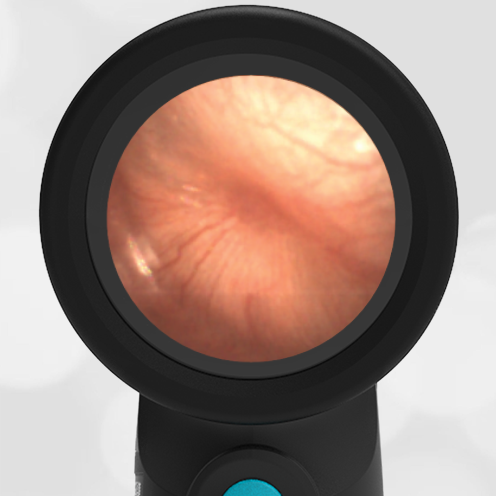
A six-year-old female is brought into the pediatric clinic with a complaint of ear pain. Four days ago, the child developed a cough, runny nose, and mild ear pain. The child reported feeling as if she had “water in her ears.” She had been doing reasonably well with over-the-counter analgesics until the day prior, when she developed a fever to 103 F and ear pain that kept her up all night. In the clinic, the child is tearful and reports “both ears are hurting.” Her temperature is 102.4 F. The following images from her ear exam were obtained with the Wispr digital otoscope.

Which of the following is true regarding the child’s presentation?
A. Her ear pain is likely related to Eustachian tube dysfunction
B. Her tympanic membranes (TMs) demonstrate moderate to severe bulging
C. She ought to be started on antibiotics to treat her acute otitis media (AOM)
D. All the above

This child’s TM is moderately bulging, as evidenced by nearly complete loss of the lateral process landmark and a deep depression centrally, where the umbo acts as a fixed attachment. Her worsening symptoms are likely due to the inflamed tympanic membranes (TMs, eardrums); however, her history of recent URI, milder pain, and fullness in her ears suggests Eustachian tube dysfunction (ETD). Since she is febrile and complaining of severe ear pain, she ought to be started on antibiotics in accordance with the AAP Clinical Practice Guideline.
The clinician should prescribe antibiotic therapy for AOM (bilateral or unilateral) in children 6 months and older with severe signs or symptoms (ie, moderate or severe otalgia or otalgia for at least 48 hours or temperature 39°C or higher). WiscMed has created an AOM treatment guide that can be found here.
Viral upper respiratory infection (URI) is one of the most frequent complaints observed in clinics, urgent care, and emergency departments, with children averaging six to eight URIs per year. In the setting of a URI, it is common for a child to experience otalgia. The challenge for clinicians is to determine if pain is due to acute otitis media (AOM) versus other conditions not requiring antibiotics, such as eustachian tube dysfunction (ETD) and otitis media with effusion (OME). Complicating the matter is that all three of these conditions commonly occur in conjunction with URI. An understanding of this relationship, as well as recognizing the physical findings associated with AOM versus OME, are keys to accurate medical decision making in the child with ear complaints. WiscMed has created a visual guide to common ear conditions that can be found here.
The eustachiann tube is the anatomic pathway venting the middle ear space to the posterior nasal pharynx. ETD can occur when viral-induced congestion blocks this pathway, inhibiting pressure equilibration across the TM, an uncomfortable sensation, as all who have flown in a pressurized airplane cabin can attest. ETD may also lead to fluid trapping in the middle ear space, i.e., a middle ear effusion (MEE). Otitis media with effusion (OME) is a MEE that is not infected. While OME may be associated with discomfort owing to the previously described pressure buildup, inflammatory changes to the TM are absent to minimal. OME is extremely common in children with URI and can be observed in developing AOM, resolving AOM, or it may bypass AOM altogether. An infected MEE is associated with inflammatory changes that result in bulging of the TM, cloudiness of the fluid, and increased pain. When these inflammatory changes are present, particularly bulging, AOM may be diagnosed and treated in accordance with the child’s symptom severity and age.
Complete exam video

